русский
  Español
  中文简体
中文简体

Industrial Vehicle Controllers: Safety from the Ground Up
Industrial vehicle controllers are the single most effective electronic component for preventing forklift and construction equipment accidents. They continuously monitor machine dynamics and intervene within milliseconds — far faster than any human operator. In the U.S. alone, powered industrial truck incidents cause roughly 34,900 injuries and 85 fatalities annually. Controllers tackle these risks head-on via redundant safety architectures, active stability functions, and real-time fault diagnostics. When integrated correctly, they transform a hazardous machine into a predictable, controlled asset.
Field data confirms the impact: fleets equipped with advanced controllers have documented 70% fewer accidents and 80% less equipment damage compared to uncoupled systems. These gains stem not from theory but from continuous, automatic speed regulation, tilt limitation, and collision avoidance — all executed by the controller without requiring operator action.
Redundant Architecture – Dual‑Core Protection
At the heart of safety lies hardware redundancy. Modern controllers employ a dual‑microprocessor design (Category 3 per EN ISO 13849) that processes every critical signal through two independent channels. If one processor fails, the second continues to monitor and control safety functions, preventing unintended motion or power loss.
Redundancy also covers dual input paths for safety‑critical sensors — throttle position, brake application, steering angle. Any mismatch between the two paths immediately triggers a safe state, typically speed reduction to creep mode or complete motor cut‑off. This complies with EN 1175:2025, which mandates minimum performance levels for safety‑related control systems.
Single‑point failures are effectively neutralised — even under severe vibration, thermal stress, or component ageing, the controller remains either fail‑operational or fail‑safe.
Active Safety Functions – Intervention Before Reaction
Beyond passive redundancy, controllers execute active safety algorithms that modify vehicle behaviour in real time, using sensor fusion and CAN‑bus communication.
Speed & Tilt Limitation
Controllers dynamically cap travel speed based on lift height, load weight, and steering angle. When a forklift lifts a heavy load, the controller automatically reduces maximum speed and restricts mast tilt angle and tilt speed to prevent forward tip‑overs. This enforcement is hard‑coded — the operator cannot override it.
Stability Control Systems
Advanced controllers integrate with multi‑sensor stability packages (e.g., 10 sensors, 3 actuators, and 1 controller). They can lock the rear axle during sharp turns to reduce sideways rollover risk and limit forward tilt when load height and position become critical. All corrections occur faster than the most skilled driver can react.
Proximity & Collision Avoidance
Proximity sensors feed data to the controller, which reduces speed automatically when pedestrians or other vehicles approach. The controller also modulates hydraulic functions (lifting, lowering, tilting) based on zone rules, improving load stability and reducing impact energy. In autonomous modes, safety‑rated controllers execute emergency stops with latencies below 100 ms.
Real‑Time Diagnostics & CAN‑Bus Intelligence
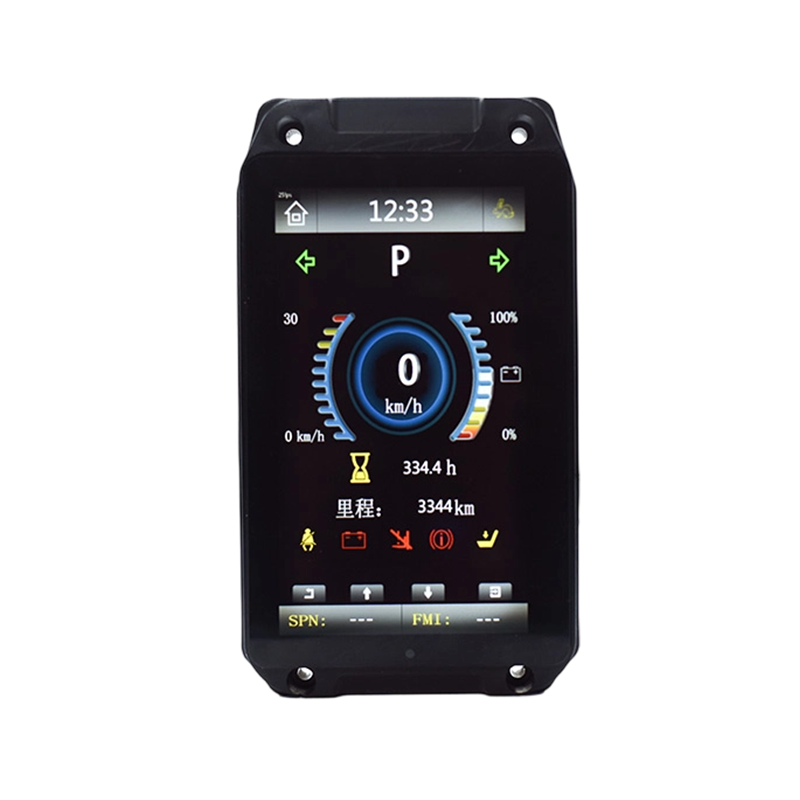
A controller’s diagnostic capability is as vital as its intervention logic. Via Controller Area Network (CAN) bus, it continuously exchanges data with battery management, sensors, and displays — monitoring voltage, temperature, state of charge, and fault codes.
Modern controllers support UDS (ISO 14229) and SAE J1939 protocols, enabling technicians to read live data, fault histories, and safety‑event logs with standard diagnostic tools. Non‑volatile memory preserves records across power cycles, aiding root‑cause analysis after incidents.
Predictive maintenance becomes possible: by tracking controller temperature, current draw, and error rates, fleet managers can schedule repairs before failures occur — reducing unplanned downtime and in‑service accidents.
Functional Safety Standards – The Compliance Backbone
Every safety controller must be validated against international standards. Compliance is non‑negotiable for legal operation and liability protection in regulated markets.
ISO 13849 – Performance Levels
ISO 13849‑1 defines Performance Levels (PL) from a to e. For each safety function, the controller must achieve a required PL (PLr) determined by risk assessment. Controllers with Category 3 dual‑channel architecture typically reach PL d or PL e, the highest reliability levels.
EN 1175:2025 – Electrical Safety for Industrial Trucks
This standard specifies minimum performance levels for all electrical/electronic components on industrial trucks. Controllers certified to EN 1175 provide OEMs and end‑users with documented evidence of compliance.
ISO 26262 – Road Vehicle Functional Safety
For on‑highway or mixed‑use vehicles, ISO 26262 applies, mandating automotive‑grade microcontrollers, master‑slave monitoring, and multi‑level torque supervision.
| Standard | Scope | Key Controller Requirement |
| ISO 13849‑1 | Safety‑related control systems | PLr assignment; Category 2/3/4 architecture |
| EN 1175:2025 | Electrical safety for industrial trucks | Minimum performance levels for safety functions |
| ISO 26262 | Road vehicle functional safety | ASIL classification; fault‑tolerant design |
| ISO 3691‑4 | Driverless industrial trucks (AGVs) | Protective field monitoring; speed/motion control |
Operational Benefits – Safety Drives Productivity
Safety and productivity are complementary, not conflicting. Controlled, predictable vehicle behaviour reduces operator fatigue and boosts confidence, while the same interventions cut product damage, equipment wear, and downtime.
Deployed systems show 70% fewer accidents and 80% less damage alongside a 15% increase in equipment utilisation. Controllers are not a cost — they are a value lever.
For construction equipment in harsh environments, ruggedised housings (cast aluminium, IP65/IP66 sealing, Gore‑Tex vents) maintain reliable operation in dust, moisture, and extreme temperatures — ensuring safety functions remain available throughout the machine’s lifetime.
Safety Intervention Workflow
The sequence below shows how a controller detects a risk and acts to prevent an incident.
Total response time: typically < 100 ms from sensor detection to actuator command.
Frequently Asked Questions
What is the most critical safety feature in a controller?
Redundant dual‑microprocessor architecture — it ensures no single component failure can disable safety functions.
How do controllers prevent forklift tip‑overs?
By monitoring load height, weight, steering angle, and speed in real time, then reducing speed, limiting tilt, and locking axles as needed.
Which standards must a safety controller meet?
ISO 13849‑1 (PL d/e), EN 1175:2025, and where applicable ISO 26262 or ISO 3691‑4 for AGVs.
Do controllers reduce maintenance costs?
Yes — real‑time diagnostics and CAN‑based logging enable predictive maintenance, cutting unplanned downtime and repair expenses.
How fast can a controller react to a hazard?
Typically under 100 milliseconds — far quicker than human reaction time (200–300 ms).