


 русский
  Español
  中文简体
中文简体


1. Introduction to In-Wheel Hub Motor Technology
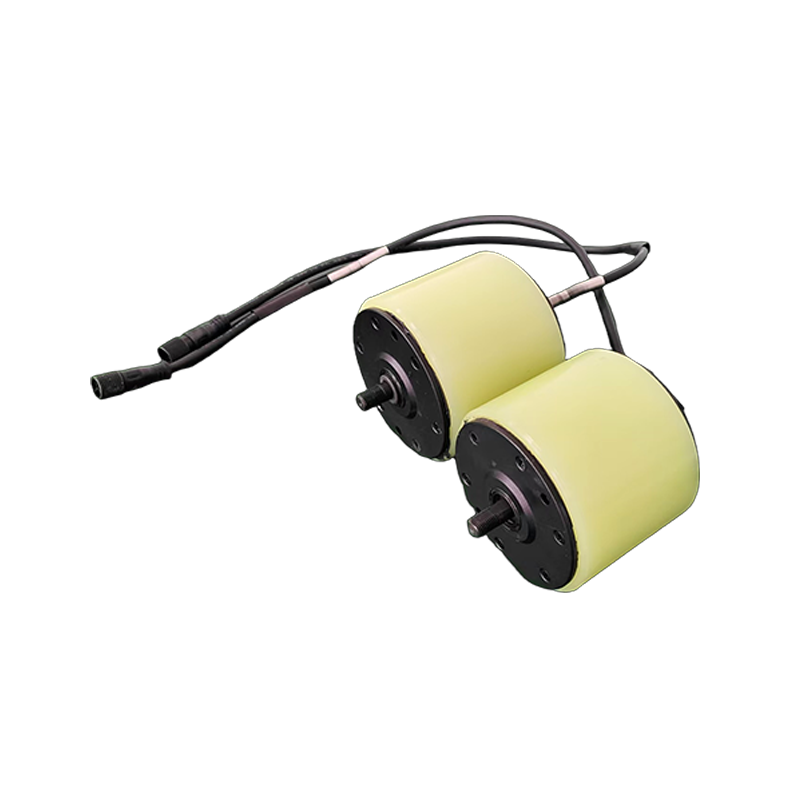
In-wheel hub motors represent a paradigm shift in industrial vehicle propulsion. By integrating the electric motor, transmission, and braking systems directly inside the wheel hub, this technology eliminates traditional mechanical components like driveshafts, differentials, and axles.
For industrial applications—such as forklifts, Automated Guided Vehicles (AGVs), and heavy-duty material handlers—this space-saving design translates to unparalleled mechanical efficiency and vehicle maneuverability. Hangzhou Fengle Electronic Technology Co., Ltd. engineers these systems to withstand harsh industrial environments while maximizing uptime and energy efficiency.
2. Core Architecture and Component Breakdown
To understand why in-wheel hub motors are superior to centralized motor systems, it is essential to look at their internal engineering. The system consolidates multiple subsystems into a single, compact housing.
2.1 The Rotor and Stator Assembly
The heart of the hub motor is the brushless permanent magnet synchronous motor (PMSM). The stator remains stationary, fixed to the vehicle chassis or suspension link, while the outer rotor rotates with the wheel rim. This configuration provides high torque density at low speeds, which is critical for moving heavy industrial loads.
2.2 Integrated Reduction Gearbox
While some hub motors are direct-drive, industrial variants often incorporate a compact planetary gearbox inside the hub. This allows the motor to operate at its optimal high-speed efficiency range while delivering the massive torque required for ramp climbing and heavy payload acceleration.
2.3 Thermal Management Systems
Industrial operations demand continuous duty cycles. Advanced thermal management, utilizing specialized cooling fins or liquid-cooling channels, ensures that heat generated by the motor and internal electronics is rapidly dissipated, preventing thermal degradation.
3. Comparison of Propulsion Architectures
Choosing the right drivetrain architecture impacts a vehicle’s lifecycle cost, maintenance frequency, and operational capabilities. The table below compares traditional centralized drivetrains with the advanced in-wheel hub motor solutions provided by Hangzhou Fengle Electronic Technology Co., Ltd.
| Performance Metrics | Traditional Centralized Motor System | Advanced In-Wheel Hub Motor System |
|---|---|---|
| Mechanical Efficiency | 75% to 85% (Due to friction losses in differentials and axles) | 90% to 95% (Direct power transmission to the wheel) |
| Space Optimization | Low (Requires significant chassis space for drivetrain parts) | Maximum (Chassis is completely freed up for batteries or cargo) |
| Maneuverability | Standard (Limited steering angles based on mechanical linkages) | Exceptional (Enables 360-degree turning, crab walking, and zero-turn radius) |
| Maintenance Needs | High (Regular lubrication of axles, universal joints, and gears) | Low (Fewer moving parts, fully enclosed system protects against dust/water) |
| Redundancy & Safety | Single point of failure (Main motor or axle failure halts the vehicle) | High Redundancy (If one wheel motor encounters an issue, others compensate) |
4. Key Engineering Benefits for Industrial Fleets
Implementing in-wheel hub motor technology directly enhances the operational capabilities of industrial material handling equipment.
4.1 Enhanced Energy Efficiency and Battery Life
Because the energy path from the motor to the ground is incredibly short, energy losses are minimized. Furthermore, hub motors maximize the efficiency of regenerative braking systems. During deceleration, the motor acts as a generator, capturing kinetic energy and feeding it back into the battery, extending the operational shift of the vehicle.
4.2 Precision Motion Control and Automation Compatibility
For AGVs and autonomous mobile robots (AMRs), precision is everything. In-wheel hub motors allow for independent torque and speed control at each individual wheel. This level of granular control is crucial for automated systems tracking magnetic tapes, QR codes, or LiDAR pathways in smart warehouses.
5. Industrial Application Scenarios
The versatile design of hub motors makes them ideal across various high-demand sectors:
- Warehousing and Logistics: Forklifts, reach trucks, and AGVs benefit from tighter turning radiuses, allowing facilities to narrow their aisle widths and increase storage density.
- Port and Container Handling: Heavy-duty transport platforms require immense torque to move shipping containers, a demand easily met by multi-wheel hub motor configurations.
- Mining and Construction: Enclosed hub motors protect vital components from mud, dust, and water ingress, ensuring reliable operation in rugged outdoor environments.
6. Why Choose Hangzhou Fengle Electronic Technology Co., Ltd.
As an industry leader, Hangzhou Fengle Electronic Technology Co., Ltd. offers distinct advantages that set our solutions apart in the global marketplace:
- End-to-End Integration: We handle everything from initial design, research and development, to high-volume production and global sales.
- Customized Engineering: We recognize that no two industrial vehicles are identical. We provide fully customized torque, voltage, and mounting configurations tailored to your specific application.
- Rigorous Quality Control: Our national high-tech enterprise status ensures that every component undergoes stringent testing for thermal endurance, shock resistance, and ingress protection.
- Comprehensive Technical Support: From initial integration consultation to aftermarket optimization, our engineering team ensures seamless implementation.
7. Frequently Asked Questions (FAQ)
7.1 How do in-wheel hub motors handle harsh environmental contaminants like dust and water?
Our hub motors are engineered with advanced ingress protection ratings (such as IP67). The fully enclosed housing prevents dust, moisture, and chemical washes from reaching the internal electrical components, making them highly reliable in dirty factory settings or outdoor environments.
7.2 Can these motors be integrated into existing industrial vehicle designs?
Yes. Hangzhou Fengle Electronic Technology Co., Ltd. specializes in creating customized solutions. We can adapt the mounting flanges, shaft dimensions, and electrical connectors to interface seamlessly with your current vehicle chassis and control systems.
7.3 What are the maintenance requirements for an industrial hub motor?
Because they eliminate external gears, driveshafts, and differentials, maintenance is significantly lower than traditional drivetrains. Periodic inspections of the primary wheel seals and checking the cooling channels are typically all that is required.
7.4 How does independent wheel control benefit autonomous vehicles?
Independent wheel control allows for differential steering, enabling vehicles to pivot on the spot or move diagonally. This eliminates complex steering linkages and allows AGVs to navigate tight spaces that traditional vehicles cannot access.
7.5 What voltages are typically supported by your industrial hub motors?
We offer scalable solutions ranging from standard low-voltage warehouse systems (24V to 48V) up to high-voltage platforms (96V and above) designed for heavy-duty engineering and construction vehicles.

