


 русский
  Español
  中文简体
中文简体
Industry News

Home / News / Industry News / What's the Difference Between 24V and 48V Industrial Vehicle Power Supply Systems?
What's the Difference Between 24V and 48V Industrial Vehicle Power Supply Systems?
Admin 2026-09-03Content
- 1 Understanding Industrial Vehicle Power Architecture
- 2 The Fundamentals of 24V and 48V Systems
- 3 Efficiency and Power Distribution Advantages
- 4 On-Board Charging Systems and Technology Integration
- 5 Real-World Applications in Industrial Settings
- 6 Total Cost of Ownership and Financial Considerations
- 7 Transitioning Between System Voltages
- 8 Key System Components and Technical Specifications
- 9 Safety and Regulatory Compliance Considerations
- 10 System Performance Comparison Visualization
- 11 Maintenance and Reliability Implications
- 12 Future Development Trends and Industry Direction
- 13 Implementation Planning and Decision Framework
- 14 Frequently Asked Questions
- 14.0.1 Q1: Can existing 24V chargers support 48V vehicles?
- 14.0.2 Q2: How much energy savings realistically occur with 48V systems?
- 14.0.3 Q3: What is the typical payback period for 48V fleet transitions?
- 14.0.4 Q4: Are 48V systems more difficult to service than 24V?
- 14.0.5 Q5: What happens to vehicle value during 24V to 48V transition?
- 14.0.6 Q6: How do 48V systems perform in extreme temperature environments?
- 14.0.7 Q7: What safety modifications are required for 48V deployment?
- 14.0.8 Q8: Can vehicles be easily retrofitted from 24V to 48V?
Understanding Industrial Vehicle Power Architecture
Industrial vehicles operate on standardized electrical systems that power everything from propulsion motors to control circuits and auxiliary equipment. The choice between 24V and 48V architectures fundamentally impacts efficiency, operational costs, and system reliability. Modern industrial operations increasingly evaluate power supply configurations to optimize performance while maintaining safety standards and reducing maintenance requirements.
The evolution toward higher voltage systems reflects broader industry trends toward energy efficiency and extended operational ranges. Understanding these differences helps fleet managers, procurement specialists, and technical teams make informed decisions about vehicle specifications and infrastructure investments.
The Fundamentals of 24V and 48V Systems
24V System Overview
Traditional industrial vehicles predominantly utilize 24V direct current systems. This voltage level became the industry standard due to safety considerations, component availability, and established manufacturing processes. The 24V architecture has powered industrial equipment for decades, creating a mature ecosystem of compatible components, service networks, and operator familiarity.
In a 24V system, power distribution occurs through dual-string battery configurations, typically using two 12V battery units connected in series. This arrangement provides consistent voltage delivery, supports extensive cable runs without excessive voltage drop, and maintains predictable charging characteristics across diverse operational conditions.
48V System Characteristics
The 48V system represents a significant shift in industrial power architecture. Operating at double the voltage of traditional systems, 48V configurations enable more efficient power delivery across vehicle electrical systems. This higher voltage directly reduces current requirements for equivalent power levels, which translates to smaller conductors, reduced heat generation, and improved overall system efficiency.
A 48V system typically utilizes four 12V battery units in series or specialized 48V battery modules. The higher voltage enables faster response times in control systems and supports more sophisticated power management strategies. Advanced on-board chargers can leverage this voltage advantage to improve charging efficiency and reduce charging cycle times significantly.
Efficiency and Power Distribution Advantages
The relationship between voltage, current, and power loss illuminates why system voltage matters. For identical power levels, higher voltage systems require proportionally lower currents. Since power loss in conductors follows the I2R principle, halving current reduces losses by 75 percent—a substantial improvement in overall system efficiency.
| Performance Metric | 24V System | 48V System |
|---|---|---|
| Required Current for 10kW Output | 416 Amps | 208 Amps |
| Conductor Size (typical) | 4/0 AWG | 1/0 AWG |
| Power Loss in 50-foot Run | 2.1 kW | 0.5 kW |
| System Efficiency Loss | 17.5 percent | 4.2 percent |
These efficiency gains compound across vehicle operational lifecycles. A fleet operating hundreds of vehicles daily experiences cumulative energy savings that significantly impact operational budgets. The reduced conductor sizing also permits lighter vehicles, decreasing material costs and improving payload capacity.
On-Board Charging Systems and Technology Integration
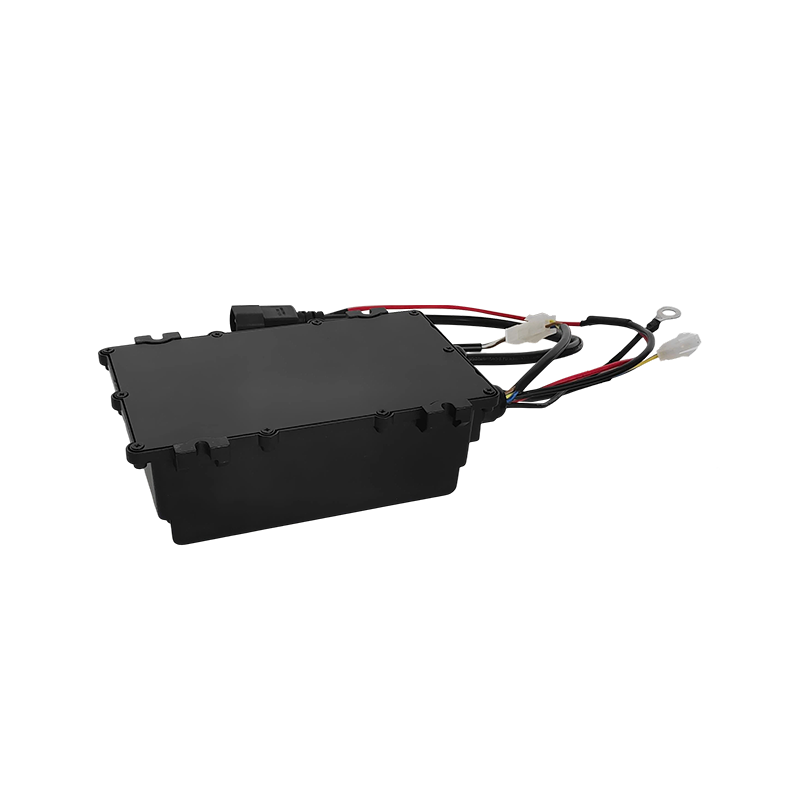
Modern industrial vehicle onboard power systems incorporate sophisticated charging management. The charger represents a critical component that bridges facility power infrastructure and vehicle energy storage. Higher voltage systems enable chargers to operate more efficiently through improved power factor correction and reduced thermal generation.
Charging Characteristics Comparison
- 24V systems typically charge at rates between 40-80 amps, requiring 4-8 hour charging cycles for complete discharge recovery
- 48V systems support charging rates between 80-200 amps, enabling 2-4 hour charging cycles with equivalent energy replenishment
- Charger efficiency improves by 8-12 percent in 48V systems due to reduced conversion losses and better thermal management
- Advanced 48V charger designs incorporate regenerative capabilities that recover braking energy during vehicle operation
- Smart charging algorithms adjust power delivery based on battery temperature, state of charge, and vehicle operational state
Power Management Features
Higher voltage systems support more sophisticated power distribution architectures. Intermediate voltage rails at 24V or 12V can be derived from the 48V main bus through dedicated converters, maintaining compatibility with legacy equipment while leveraging 48V efficiency advantages. This approach enables gradual fleet transitions without complete equipment replacement.
Real-World Applications in Industrial Settings
Forklift Operations
Material handling vehicles represent the largest segment of industrial vehicle deployments. Traditional 24V forklifts operate effectively in standard warehouse environments with consistent charging infrastructure. Modern 48V designs enable extended operation periods, reduced charging downtime, and improved lifting performance under demanding conditions. The efficiency advantages become particularly significant in high-throughput operations where vehicles operate 16-20 hours daily across multiple shifts.
Automated Guided Vehicles (AGVs)
Autonomous logistics operations benefit substantially from 48V system deployment. The improved power management capabilities support sophisticated sensor arrays, communication systems, and motion control electronics. The reduced electrical noise from lower current operations improves sensor accuracy and reduces electromagnetic interference with facility networks. Extended operating ranges enable AGVs to serve larger warehouse areas without intermediate charging events.
Specialized Heavy Equipment
Specialized industrial applications including mining vehicles, agricultural equipment, and construction machinery increasingly adopt 48V architectures. These applications demand robust power delivery under extreme operating conditions. Higher voltage systems provide superior performance in cold environments where battery efficiency naturally degrades. The improved voltage stability under high current loads ensures consistent equipment operation across demanding use cases.
Total Cost of Ownership and Financial Considerations
Procurement decisions must consider comprehensive cost structures beyond initial vehicle acquisition. The following elements influence overall financial performance:
- Energy consumption represents 35-45 percent of industrial vehicle operating costs over a 10-year lifecycle
- 48V systems reduce energy consumption by 15-25 percent depending on operational intensity and cycle patterns
- Reduced conductor sizing and weight in 48V systems decrease manufacturing costs by 8-12 percent despite higher per-unit component expenses
- Charger equipment investments differ, with 48V chargers typically costing 20-30 percent more initially but delivering superior long-term value
- Battery replacement cycles extend 15-20 percent longer in efficiently managed 48V systems, reducing capital replacement frequency
- Maintenance costs decline due to reduced thermal stress and superior electrical stability in 48V architectures
A fleet operating 200 vehicles performing 8 hours daily operation calculates total 10-year energy costs of approximately 2.1 million units in 24V systems versus 1.6 million units in comparable 48V deployments, yielding 500,000 unit savings despite higher initial infrastructure investment.
Transitioning Between System Voltages
Phased Implementation Strategies
Fleet operators rarely replace entire vehicle populations simultaneously. Strategic transition planning enables organizations to realize 48V benefits while preserving existing 24V asset investments. Hybrid fleet operations leverage both voltage systems through infrastructure modifications and management practices that optimize operational performance.
Infrastructure Requirements
Charging infrastructure represents the largest transition consideration. Organizations can deploy dual-voltage charging stations supporting both 24V and 48V vehicles, enabling gradual fleet conversion as existing vehicles reach end-of-service. Facility power requirements remain similar across voltage systems, with 48V implementations actually reducing facility electrical upgrades in congested charging areas due to lower current demands.
Training and Operational Adjustments
Vehicle operators require minimal retraining when transitioning to 48V systems. Modern control interfaces present identical information regardless of underlying voltage architecture. Maintenance technicians need system-specific training focusing on higher voltage safety procedures and component isolation protocols. Organizations typically develop transition timelines spanning 3-5 years to accommodate training completion and knowledge dissemination across technical staff.
Key System Components and Technical Specifications
Battery Technologies
Lead-acid battery configurations dominate industrial vehicle applications. Traditional designs utilize twelve 2V cells configured in series—creating six 12V units (two strings of three units each) for 24V systems or eight 12V units (four strings of two units each) for 48V systems. Lithium iron phosphate battery adoption accelerates across both voltage systems, offering superior energy density, extended cycle life, and improved thermal management. Energy density advantages of lithium chemistry compound when applied to 48V architectures, reducing vehicle weight and improving operational efficiency further.
DC-DC Converter Architecture
Modern industrial vehicles incorporate sophisticated industrial vehicle power supply integration through DC-DC converter technology. These components regulate voltage distribution to auxiliary systems operating at different levels. Isolated converter designs provide independent power domains for sensitive control electronics, improving system reliability and electromagnetic compatibility. Conversion efficiency ratings of 94-98 percent minimize energy waste while supporting simultaneous multi-voltage distribution from single main battery sources.
Control and Monitoring Systems
Battery management systems continuously monitor cell voltages, temperatures, and charge states. Advanced implementations incorporate predictive algorithms that forecast battery remaining life, optimize charging strategies, and alert operators to developing fault conditions before failure occurs. Real-time performance monitoring enables fleet managers to identify maintenance needs, optimize maintenance scheduling, and track energy consumption patterns across vehicle populations.
Safety and Regulatory Compliance Considerations
Industrial vehicle electrical systems operate under stringent safety standards designed to protect personnel and facility infrastructure. Both 24V and 48V systems comply with established safety regulations, though specific requirements differ based on voltage levels and operating environments.
Electrical Safety Standards
24V systems benefit from decades of safety protocol development and standardization. Component isolation requirements, connector specifications, and protection device characteristics are thoroughly documented and universally understood across industries. Personnel safety risks remain low due to well-established practices and universal component compatibility.
48V systems operate below classification thresholds for high-voltage equipment in most regulatory frameworks but require specific safety protocols for personnel protection. Insulation requirements, grounding specifications, and protective device design differ from 24V systems. Modern 48V standards incorporate these requirements comprehensively, but organizations must ensure comprehensive training and compliance procedures throughout fleet operations.
Environmental and Operational Standards
Industrial vehicle standards address electromagnetic compatibility, thermal management, and operational reliability. Both voltage systems achieve equivalent environmental performance when designed to current standards. Newer 48V implementations often exceed 24V baselines due to advanced design methodologies and modern component performance characteristics.
System Performance Comparison Visualization
Maintenance and Reliability Implications
Component Longevity
Electrical components experience stress proportional to current levels and thermal generation. Lower current operations in 48V systems reduce connector heating, cable insulation stress, and component thermal cycling. These factors directly extend component service life across chargers, converters, and distribution equipment. Empirical data indicates 48V systems achieve 15-20 percent longer component lifecycles compared to equivalent 24V installations under comparable operational intensity.
Troubleshooting and Diagnostics
Modern vehicle electrical systems incorporate comprehensive diagnostic capabilities supporting rapid fault identification. Both 24V and 48V platforms provide equivalent diagnostic depth through battery management systems and control area networks. Technicians benefit from identical troubleshooting methodologies and repair procedures regardless of voltage architecture. Specialized diagnostic equipment operates across both platforms without modification.
Spare Parts and Service Networks
24V system components enjoy extensive availability through established supply chains spanning multiple decades. 48V components show rapidly expanding availability as adoption accelerates across industrial sectors. Organizations transitioning to 48V systems should coordinate spare parts inventory development alongside fleet conversion planning to ensure service capability throughout transition periods.
Future Development Trends and Industry Direction
Electrification Acceleration
Industrial vehicle electrification continues accelerating across all application categories. Regulatory pressure, energy cost escalation, and performance advantages drive rapid adoption of advanced power systems. 48V architectures position manufacturers and operators at the forefront of this transition, enabling preparation for emerging electric propulsion technologies anticipated over the next decade.
Battery Chemistry Evolution
Lithium iron phosphate chemistry dominates emerging industrial vehicle applications. Solid-state battery development promises further improvements in energy density, charging speed, and thermal stability. These advances amplify 48V system advantages while potentially enabling entirely new vehicle categories and operational capabilities. Organizations investing in 48V infrastructure today prepare for seamless integration of tomorrow's battery technologies.
Smart Fleet Management Integration
Advanced fleet management platforms increasingly leverage vehicle electrical system data for optimization. 48V systems provide superior data fidelity and real-time monitoring capabilities supporting predictive maintenance, dynamic routing, and energy consumption optimization. Future systems will likely require 48V capabilities as standard, making this architectural choice fundamental to long-term fleet competitiveness.
Implementation Planning and Decision Framework
Assessment Methodology
- Analyze current fleet age distribution and remaining service life expectations
- Calculate total operating costs including energy, maintenance, and downtime expenses
- Evaluate facility infrastructure capacity for dual-voltage charging deployment
- Assess personnel training requirements and technical capability maturity
- Examine regulatory environment and future compliance trajectories
- Project technology obsolescence risk for existing 24V investments
- Identify operational flexibility gains from extended range and reduced charging time
Financial Decision Framework
Organizations should prepare comprehensive business cases comparing 24V continuation versus 48V transition investments. Analysis should span minimum 10-year horizons capturing full vehicle lifecycle economics. Scenarios should model various electricity cost trajectories, inflation rates, and technology advancement impacts. Conservative projections demonstrate positive return on investment for organizations with high-intensity vehicle utilization, extensive charging infrastructure, and extended planning horizons.
Frequently Asked Questions
Q1: Can existing 24V chargers support 48V vehicles?
No. 48V chargers require different electrical architecture, control algorithms, and safety protection schemes. Direct substitution risks equipment damage and safety hazards. Organizations must deploy dedicated 48V charging equipment or dual-voltage charging stations supporting both voltage levels.
Q2: How much energy savings realistically occur with 48V systems?
Typical energy consumption reductions range 15-25 percent depending on operational patterns and charging infrastructure efficiency. High-intensity operations with frequent short-interval charging cycles realize greater savings than low-utilization applications. Real-world performance requires measurement across specific vehicle populations under actual operating conditions.
Q3: What is the typical payback period for 48V fleet transitions?
Organizations with 150+ vehicle fleets operating 8+ hours daily typically achieve payback within 3-4 years when accounting for energy, maintenance, and downtime savings. Smaller operations or lower utilization patterns may require 5-7 year payback periods. Individual circumstances vary significantly based on operational intensity and local electricity costs.
Q4: Are 48V systems more difficult to service than 24V?
Service complexity differs minimally between voltage architectures. Technicians require voltage-specific training emphasizing proper electrical isolation and grounding procedures. Modern diagnostic equipment provides equivalent functionality across both platforms. Training investment remains modest relative to operational cost savings achieved through system advantages.
Q5: What happens to vehicle value during 24V to 48V transition?
Secondary market demand for 24V vehicles remains strong throughout transition periods as organizations maintain mixed fleets. Used 24V vehicles retain adequate value for organizations planning fleet conversion over extended timelines. However, residual values decline as 48V becomes industry standard, suggesting accelerated transition may preserve asset value for organizations considering fleet sales.
Q6: How do 48V systems perform in extreme temperature environments?
48V architectures provide superior cold-weather performance through more stable voltage regulation and improved control system responsiveness. Higher voltage margins better accommodate battery efficiency degradation at low temperatures. Thermal management improvements in 48V chargers and converters support superior performance across extreme temperature ranges compared to 24V equivalents.
Q7: What safety modifications are required for 48V deployment?
Personnel protection procedures require additional insulation requirements and electrical isolation protocols during maintenance. Proper training in 48V safety practices represents the primary organizational investment. Modern 48V equipment incorporates redundant protection systems exceeding safety standards, creating equivalent or superior safety profiles compared to 24V systems when deployed with proper protocols.
Q8: Can vehicles be easily retrofitted from 24V to 48V?
Complete retrofits prove technically challenging and economically inefficient for most vehicle types. New vehicle acquisition represents the practical transition methodology for most organizations. However, certain modular subsystems including charging equipment and power management electronics can transition to 48V in existing vehicle architectures through targeted upgrades.
For exclusive deals and latest offers, sign up by entering your email address below.


CONTACT
- 88 Chuangye Street, Qingshanhu Street, Lin 'an District, Hangzhou City, Zhejiang, China
- fldz@fengletech.com
- +86-571-61097576
- +86-13721109386
- +86-15067105688
NEWSLETTER
Contact us today to get your exclusive solution and quote.
We promise never to disclose your privacy.
Copyright © Hangzhou Fengle Electronic Technology Co., Ltd. All Rights Reserved
Custom Forklift Electrical Parts Manufacturers
